
THE SCIENCE INSIDE HTX3000-PRO
The Luneburg Lens, Explained
Invented in 1944. Proven on radar and stealth aircraft. Now focusing WiFi in your home.
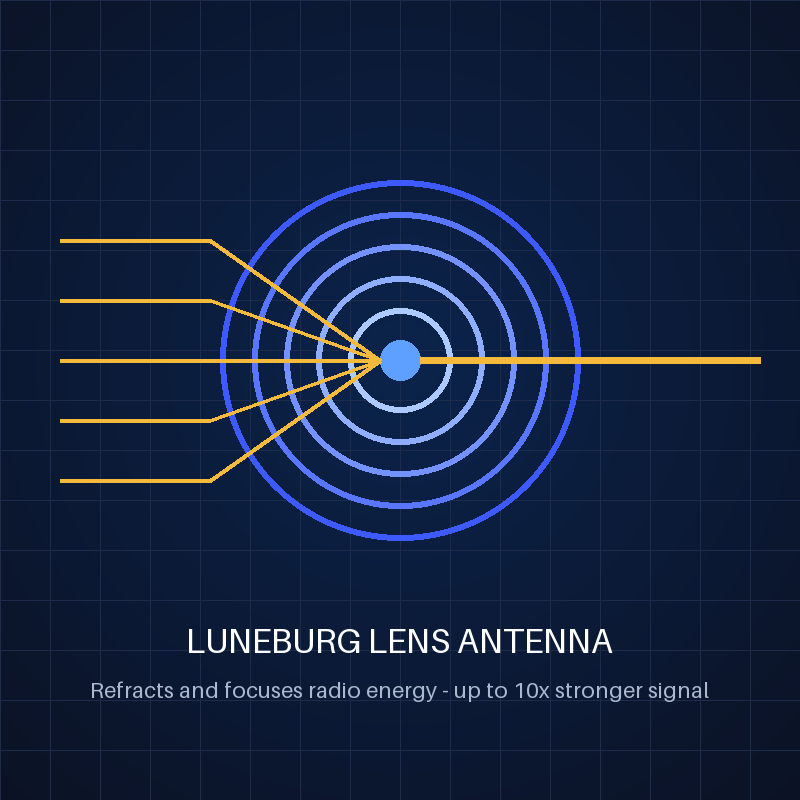
A lens for radio waves
Proposed by mathematician Rudolf Luneburg in 1944, the Luneburg lens is a sphere built from layers of material with gradually changing refractive index — like an onion where every layer bends radio waves a little more. The result: weak, scattered radio energy entering one side is focused into a concentrated, high-gain beam on the other. It is, quite literally, a magnifying glass for WiFi.
Two physical advantages no firmware can fake
- Focused energy: weak signals are concentrated into high energy density — up to 10× the signal strength of a conventional router antenna, with 12 dBi gain on 5 GHz.
- Wider vertical beam: the lens spreads coverage vertically as well as horizontally — which is how one unit on floor 2 can serve floor 1 through an atrium, verified in hospital field tests.
From classified to commercial
Luneburg lenses fly on stealth aircraft as radar reflectors and sit atop 5G base stations. Xi'an Haitian Antenna Technologies pioneered the artificial dielectric formula and manufacturing process in China — 27 granted patents (12 invention patents) and 10 software copyrights — then miniaturized it into the HTX3000-Pro, the world's first lens-antenna WiFi router.